|
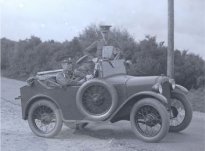
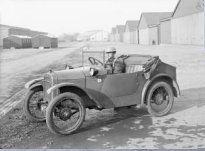
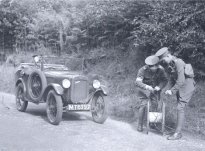
The Austin Motor Company at Longbridge produced a variety of
their small 'Seven' series vehicles for Army use during WW1 & WW2.
|
|
|
|
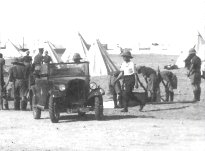
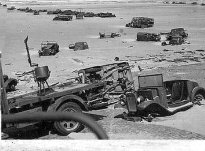
Wartime
Austin Sevens in action including one left behind at Dunkirk. |
|
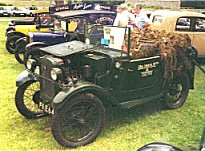
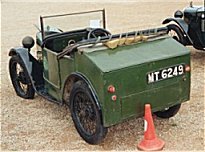
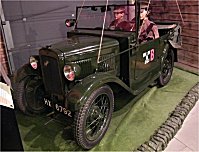
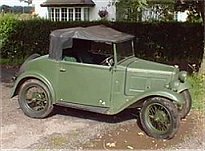
Pictured
below are a few rare restored examples in various guises today including Olive.
|
|
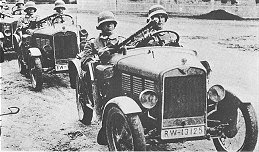
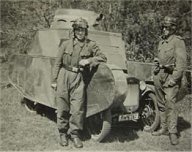
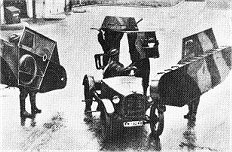
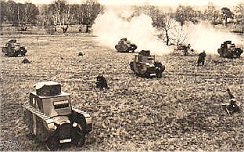
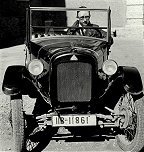
Germany
manufactured Austin Sevens under licence from Austin and was BMW (Bavarian
Motor Works) first car - It was named the BMW Dixi and here it is being used by
the Wehrmacht with a front mounted MG34 Machine Gun and also under disguise as
a tank, with plywood sides and gun turret - SS Reichsführer Heinrich
Himmler takes his Dixi for a drive! |
|
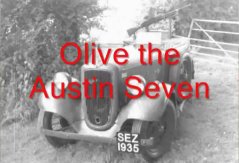
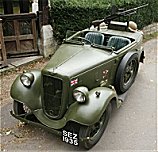
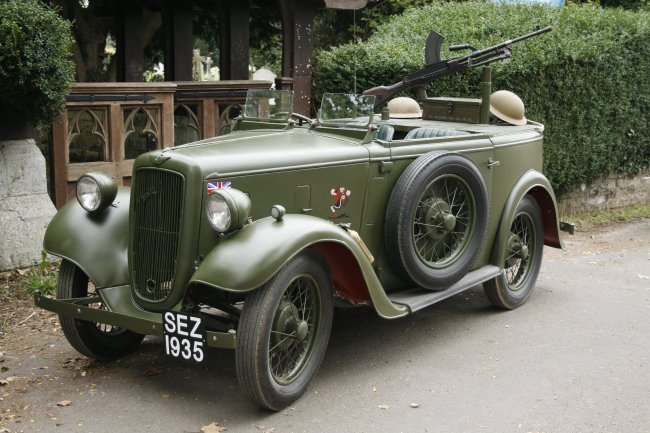
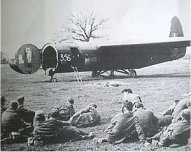
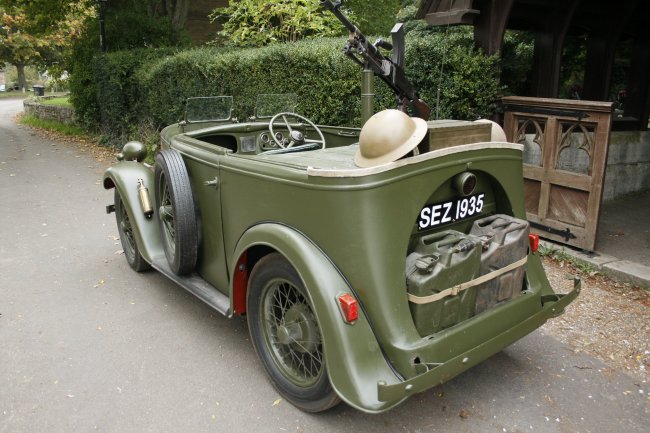
Olive is a
1935 Austin 7 Ruby adapted to the guise of one of the vehicles used by the
British military in early 1944. It is believed that a few of these little cars
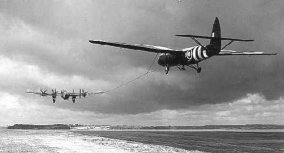
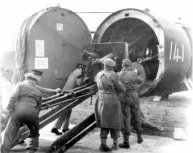
were modified and transported by glider across the English channel by either
Halifax, Sterling or Albemarle aircraft from an airfield near the south coast
and released over occupied northern France with possibly soldiers from the
Royal Signals or SOE, Winston Churchills 'Special Operations Executive'. Their
sole aim to gather last minute but valuable intelligence, by use of their heavy
communications equipment, prior to the Normandy landings in June of that
year. |
|
We are proud
of our achievement boasts Olives owner Kim Leachman from Holdenhurst Village
near Bournemouth and together with good friend Stuart Hiscock, the two
self-confessed petrol heads and Austin Seven enthusiasts have spent many hours
of their spare time on her reconstruction. There is no known photographic or
historical evidence to confirm the existence of such vehicles says Kim other
than that told to me by my late father and grandfather whom themselves worked
for Vickers Aviation and Harland and Wolff respectively during the 40's and
50's. Both companies being heavily involved with the war effort and especially
Operation Overlord the codename for the D-Day invasion. Stuarts father was an
Aircraft Armament Technician in the Royal Air Force. |
|
The eighty
one year old Austin has undergone a total bodywork and mechanical restoration
using original and reconditioned parts to the specifications of the drawings,
sketches and verbal information given to me many years ago by my father. Both
he and my grandfather told me convincingly that the vehicles had been obtained
and modified locally at Hurn Aerodrome and Airspeed Limited in Christchurch
where the Horsa Gliders were manufactured. Horsa gliders were most famously
used for the capture of the Pegasus bridge which spans the river Orne in France
during the early hours of D-Day. |
|
Hurn, once
a main staging area for bombers and fighters during WW2 is now better known as
Bournemouth International Airport. Airspeed, adjacent to Christchurch airfield,
was replaced in the 70's by an Industrial complex and housing estate, but the
road still bears the name of Airspeed Way and other surrounding roads have
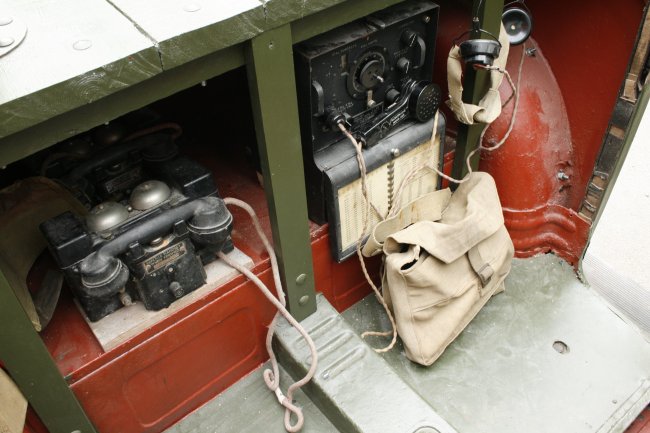
aircraft names. The two seater 750cc 7hp car features a .303 caliber Bren
machine gun mounted on a wooden platform inplace of the rear seats. A period
radio transmitter and field telephone are stored underneath, alongside Walter
the Carrier Pigeon in his basket! |
|
An
interesting historical note is the role these cars played in the development of
the jeep. The American Bantam Company was formed from the American Austin
company, which was set up to produce Austin 7's in the USA under license in the
1930's. Bantam used them to develop military cross country scout cars, which
led to the jeep prototypes. The Austin 7 Military Tourer can honestly claim to
be the original jeep prototype! |
|
It is hoped
that by restoring such a mythical vehicle and photographing and videoing its
progress it may assist with any historical research of either the vehicles or
their mission with military historians. Three years ago, Kim invited the
secretary of the Dorset Austin Seven club, Phil Whitter, who carries the
authority of the DVLA to officially inspect, date and authenticate the motor
car - he was very impressed with Olive says Kim and now, since gaining her MOT
and V5 registration document, she is now able to display her very own
registration number SEZ 1935. |
|
Affectionately named 'Olive' after her shade of olive drab green
paint, the 1935 Reconnaissance war machine features a cartoon of Olive Oyl
painted on each side of her bonnet with the slogan 'Olive sez 1935!' - She has
also, with her two man crew of Private Partz and Major Cockup, been used as a
display vehicle for the Royal British Legion plus the Help for Heroes charities
and has raised funds for both causes - Git yor 'air cut Lad! |
|
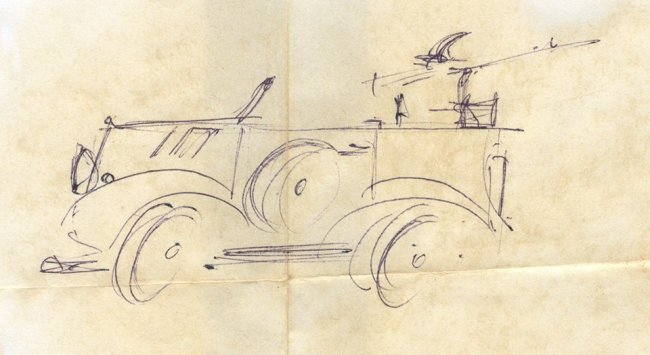
The original
drawing my Father drew for me back in the early sixties of one of the six
Austin Seven Reconnaissance cars, that he remembers at Vickers Aviation, now
British Aerospace, back in the forties, where he worked as a young trainee
technician. This set me on the road to find one! |
|
Olive now
appears in the book ' Union Jack & Jerry Can', written about British
Utility & Light Reconnaissance Vehicles from both WW1 & WW2, complied
by four German Military Historians and published by Helios Books in June 2016.
|
 |
|
I
am currently writing a book about Olive and once published I am to donate any
royalties any sales may bring, to three charities, that mean a lot to me,
namely, The Royal British Legion , Help for Hero's and the Steve Bernard
Foundation, a local Registered Charity ,that helps to provides financial help
for Under Priveledged Children. The book, with some illustrations by myself, is
about her one off Top Secret WW2 mission to Northern France, which involved her
two man crew, the French Resistance, lead by a stunning young local woman
Madame Monique Denby and a 45 ton German Panzer Tank, with a vindictive and
vengeful crew of four, commanded by German Waffen-Commander Herr Klaus Dieter
Rouch, insistent on hunting Olive down! It is hoped that from the book, a movie
may be undertaken, with a proportion of the Box Office takings, being awarded
to the charities too! The quiet Dorset village where Olives owner resides and
which resembles a small French hamlet with vintage buildings and old cottages
with rolling Farmland and Farm would be a suitable location and is available
for any film production throughout the year. I await to hear from any wealthy
business people, willing to help my cause and to help others and I Thank You
All, Yours, Kim Leachman: 0759 454 7845 www.army7.co.uk
|
| t |
|
|
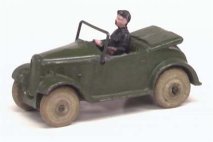
The
Austin seven cars that are atributed with military use are those with the early
flat rad design - being the APD series. The only evidence of any later 'Jewel'
, Ruby, Pearl & Opel types being used (with the newer style sloping grill)
is this photograph of a Dinky toy model below based on a PD type Military
Tourer from 1937. |
 |
|
A
very special thanks must go to the several very important people that were
involved with Olives reconstruction since 2002, namely my lovely, dear old Dad,
Howard Leachman, who sadly passed away in 1995. To me, he was the nucleus for
the project and who would have been extremely proud of both myself, all of my
friends and associates and of course, the little car itself - how he would have
enjoyed, working on it too! Julian 'Hooligan' Hiscock and his elder brother
Stuart both from Bournemouth, who worked tirelessly and into the early hours,
sometimes in minus five degree conditions, with Hooligan, also helping to prime
and prepare her bodywork and wire wheels, whilst both helped every Friday
night, helping to dismantle the vehicle and slowly putting her back together,
with welding advice coming from Stu's working colleague and friend and now
mine, Tony Bernard who's welding experience came from his work on Oil Rigs,
back in the day and that helped a lot! All her ancillary engine parts were
reconditioned by Tony Leslie from Holmesdale Sevens in Sessex, whilst the
Engine itself was re-asembled by Austin Seven mechanical Wizard, Willie
Mackenzie from his ARP workshop in Poole, who sometimes had a fair few
derogatory remarks about Stuarts and my own, early Engineering skills, calling
us on one occasion and in a strong Scottish accent -"a couple a
schunts"! Elecrical items and a few other bits and bobs were supplied by
David Cochrane of Austin 7 Components in Rugby, Warickshire and the wiring
itself, was put in by our good friend, Stephen 'Brains' Bailey, an Auto
Electrical Engineer from just around the corner. Dorset Austin Seven Clubs DVLA
approved vehicle authenticator, Phil Whitter, inspected and authorized Olive
for registration and finally Glyn Llewellyn and Gary Munn from Munwellyns
Engineers of New Milton and Parkstone, checked Olive over and issued her with a
clean bill of health, after a steering bolt loosened and myself and Stuart had
careered into the back of a parked Peugeot in Holdenhurst Village and wrote it
off! Olive suffered a few broken parts and we were lucky enough, just to hurt
our pride! |
| CLICK PIC TO PLAY VIDEO OF OLIVE & THERE ARE OTHER VIDEOS
OF HER ON YOUTUBE TOO! |
|
Based:
Bournemouth Dorset (South Coast) United Kingdom |
|
Tel:
Bournemouth 01202 397070 Mob: 0759 454 7845 |
|

 https://www.facebook.com/pages/Olive-the-Austin-Seven/280287035511259